Thought Leadership
For many practices, patient education is not just a communication issue - it’s a barrier that directly impacts outcomes, compliance, and long-term care. So why does this gap still exist? Read our article to find out more.
1 Jun 2026
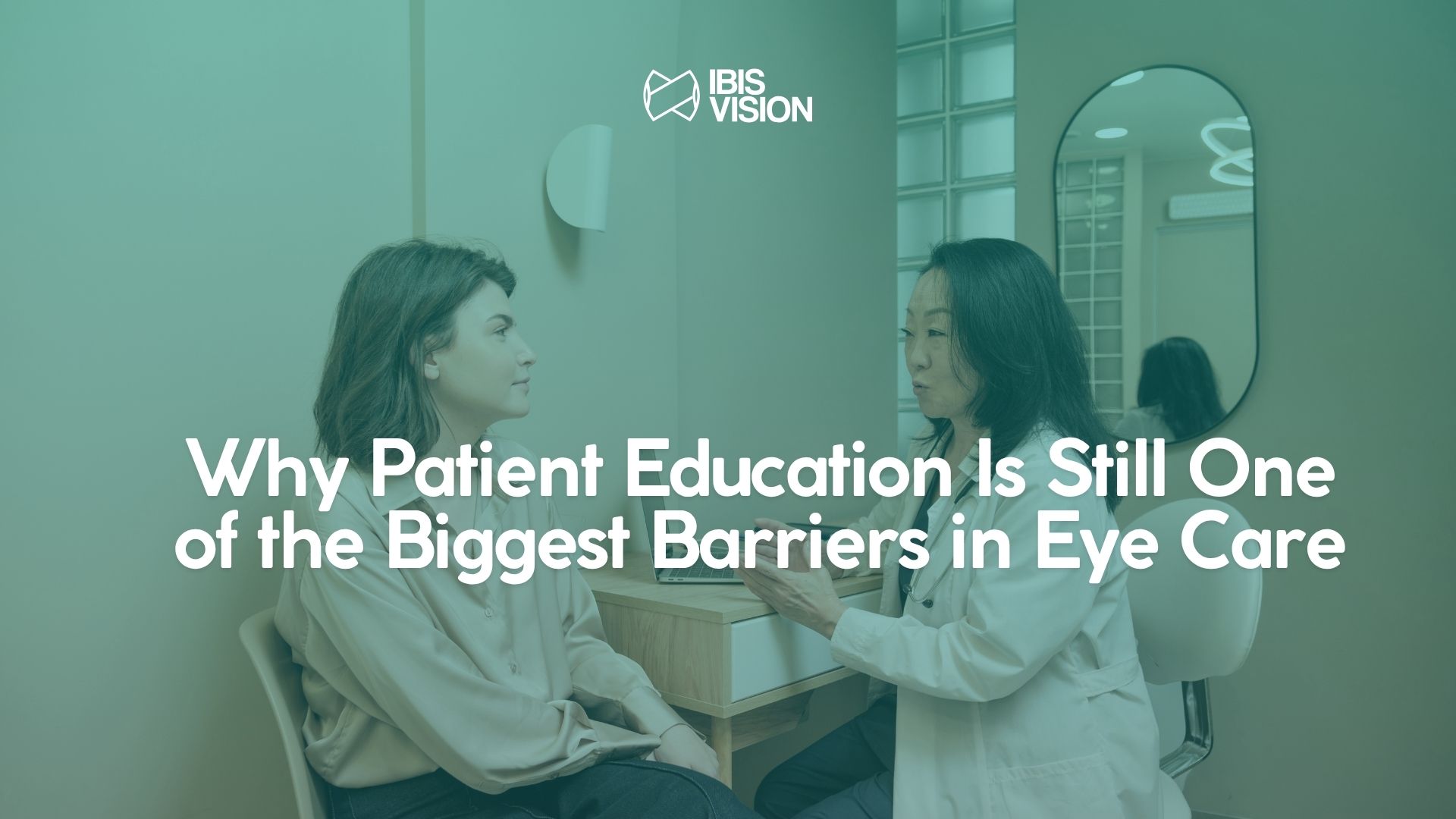
Despite advances in diagnostic technology and clinical expertise, one of the most persistent challenges in eye care hasn’t changed: ensuring patients truly understand their eye health.
For many practices, patient education is not just a communication issue - it’s a barrier that directly impacts outcomes, compliance, and long-term care.
So why does this gap still exist?
The reality: patients don’t retain what we tell them
Even when explanations are clear and clinically sound, patients often leave the consultation with only a partial understanding of what they’ve been told.
This isn’t a reflection on clinicians - it’s human nature.
In a typical appointment, patients are:
Processing unfamiliar terminology
Trying to remember recommendations
Often feeling anxious about potential diagnoses
As a result, key information is forgotten almost immediately. Instructions around monitoring, follow-ups, or lifestyle changes can quickly become lost once the patient leaves the practice.
For conditions that rely on early detection or ongoing management, this lack of retention can have serious consequences.
The constraint: Time is not on your side
Modern eye care practices are under increasing pressure to see more patients without compromising care quality.
This creates a difficult trade-off:
Spend more time explaining - risk running behind schedule
Keep consultations efficient - risk reduced patient understanding
Explaining retinal findings, disease progression, or risk factors properly takes time - time that many clinicians simply don’t have.
The result?
Patient education often becomes:
Compressed
Simplified
Or rushed
Even the most experienced practitioners are forced to prioritise efficiency, which can unintentionally limit how much patients truly absorb.
The challenge: Complexity of what we’re trying to explain
Eye care is inherently visual and highly technical.
Trying to communicate:
Subtle retinal changes
Early-stage disease indicators
Risk vs urgency
The need for ongoing monitoring
- is not straightforward.
Patients don’t see what clinicians see. And, without clear visual or contextual support, these explanations can feel abstract or unclear.
This leads to common outcomes:Patients underestimate the seriousness of findings
Or, conversely, become unnecessarily worried
Follow-up adherence drops
Trust and confidence can be affected
Why this matters more than ever
The industry is shifting toward:
Early detection
Preventative care
Data-driven decision-making
But these advances only deliver value if patients:
Understand their condition
Recognise its importance
Stay engaged in their care
Without effective patient education, even the best clinical insights risk being underutilised.
Rethinking patient education in practice
Addressing this challenge isn’t about asking clinicians to “do more” in already limited time.
It’s about changing how information is delivered and reinforced.
Forward-thinking practices are starting to:
Use visual tools and online systems to support explanations
Provide digital follow-ups
Simplify complex findings into patient-friendly narratives
Integrate education into the workflow rather than adding to it
The goal isn’t longer consultations - it’s more effective ones.
The opportunity
Improving patient education is one of the clearest opportunities in eye care to:
Increase patient engagement
Improve clinical outcomes
Reduce missed follow-ups
Strengthen trust
And importantly, it benefits both sides of the consultation:
Patients feel informed and empowered
Clinicians feel confident their message has landed
In a field driven by precision and early detection, clarity of communication is just as critical as accuracy of diagnosis.
Because the impact of what we see clinically is only as strong as what patients understand - and act on - after they leave the chair.



stay in the loop